Posts

Showing posts with the label Photography

Occultation of Mars: January 13, 2025

Image
 Monday evening 1/13, I got to see the Moon occult Mars. The forecast was for clear skies, but there were variable clouds throughout the day, and the Moon wasn't visible when I left work after 5pm and headed for my observing site.  The western sky an hour after sunset Clouds near the Moon After a nice sunset, the Moon broke through, and I was able to start a photo sequence (Canon 90D, 100-400mm lens plus 1.4x teleconverter) and get to my 10" scope just after first contact. The seeing was pretty bad, with no detail on Mars.  Mars about to disappear While Mars was covered, I turned to Jupiter and caught Ganymede, Io, and Callisto in a tight diagonal line on one side of the planet. Europa was on the other side. It was a pretty unusual configuration. Jupiter and moons at 6:27pm The clouds had thinned out as I prepared for Mars to reappear. I got the camera set up, and then went back to the scope. Seeing was a little bit better. The first bit of Mars that peeked out seemed to ...

Meteor Shower Year in Review for 2023

Image
During 2023, I was able to get out on 12 different occasions to observe and count meteors. This is better than most years, and I attribute that to increased effort as well as some fortunate weather. The Moon didn't impact as many shower peaks in 2023 as in most years, so that was favorable. The good weather didn't always land on the exact peak date of the shower, so several of my sessions were away from the peak but while the shower was producing noticeable activity. The showers on my Major Meteor Showers of 2023 outlook that I didn't pursue were the Quadrantids and the Eta Aquariids, both wiped out by bright moonlight. As I'm working on my 2024 outlook and plans, I figured I would relive this past year. I submitted my observations to the International Meteor Organization when conditions permitted, and it turns out that I spent just shy of 34 hours counting meteors (and/or waiting for meteors to count 😀). I logged 1463 meteors during these sessions. I spent more time...

Annular Solar Eclipse: October 14, 2023

Image
Chiloquin, OR Early morning was promising: 8:02am through a solar filter After an hour of nothing: 9:15am, filtered only by clouds from here until 10:08am 9:17:16am 9:17:30am - Predicted beginning of annularity 9:17:32am 9:17:38am 9:17:56am 9:17:56am: The color remix 9:18:37am: A pseudo-total eclipse 9:19:58am: "Ring of Fire" in subtle color 9:19:58am: "Ring of Fire" with saturation and contrast dialed up 9:20:38am 9:45am 10:08am with no clouds through a solar filter

Another Aurora, April 23/24, 2023

Image
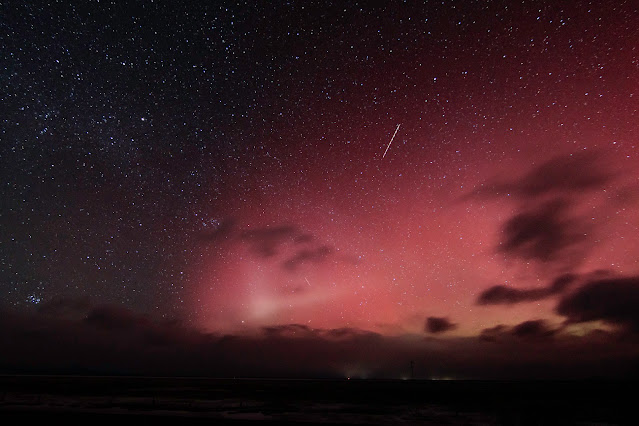
One month since my last aurora adventure, the Northern Lights struck again, and once again I was dodging clouds and an uncertain duration of auroral activity. I went to Howard Bay on the west side of Upper Klamath Lake, and only wish that I had ignored the clouds and twilight and gotten there a little bit sooner. First quick shot, 9:11pm 9:40pm: I liked this framing with the Big and Little Dippers Bright curtain at 10:15pm 12:23am: The peak of the "last act"

Aurora Borealis March 23/24, 2023

Image
For the first time in almost 8 years, I saw a significant display of the Aurora Borealis (Northern Lights). It was a bit of a slog, though. I had looked at Spaceweather.com in the morning and seen the possibility for some auroral activity over the next day, but forgot about it during work and even after work as I ate supper and watched the end of a basketball game. Most of the time, these aurora forecasts either fizzle, or the auroras aren't visible as far south as Southern Oregon, or the storm is over by the time night falls here. Or it's cloudy. The weather during the afternoon was a full-on blizzard at times. During evening twilight, I made a grocery run and noticed it had cleared off. Venus and the Moon were in a pleasing formation, with Jupiter far below. But I didn't remember to check on the aurora. Both of the late tournament games went down to the wire, and it wasn't until after those ended that I thought about checking in on the space weather again. When I did...

Mars Occultation December 7, 2022

Image
It was supposed to be clear. It wasn't. Low clouds and fog stayed around all day and were still present when I got off work after 5pm. All of my close, low-elevation observing sites were under the blanket judging from the satellite images. I needed to go up in elevation to get off the basin floor. Unfortunately, there had been a snowstorm last week, so road conditions over the Cascade passes looked dubious. I needed somewhere I could get to in under an hour. Also, I didn't have a Sno-Park permit. So going west wasn't a great option. The other clear place on the satellite image was to the northeast. There is a 5000' pass at Bly Mountain, and the roads looked okay. I wasn't sure that I was going to make it up there in time, or exactly where I would set up if I did, but I decided to give it a shot. I already had my scope pre-cooled in the car (from an excellent Mars observing session the previous night ), so I threw in the accessory cases, binoculars, camera and tripod...

Orionid Meteor Shower 2022

Image
The Orionid meteor shower is a bit of an old friend. I casually observed lots of Orionids in 1993, and since then I've tried to get out for it whenever conditions warranted. It's been a mixed bag. The Orionids produced more than double their normal rates in 2006 and 2007, and I saw lots of them in 2010 as well. Other years have featured much lower numbers, such that I add this disclaimer to my annual meteor shower outlook: I never know what to expect from this shower. I wasn't sure how much time I was going to dedicate to the Orionids this year. Work has been a bear and my dad ended up in the hospital on October 18th. But the good thing about meteor observing is that it uses hours that we normally don't need for anything other than sleep, and in October darkness lingers late enough that it's possible to get a decent amount of sleep before waking up to do a meteor watch. The forecast was promising for Thursday and Friday mornings, October 20th and 21st. The nominal s...

Leona's Little Blue

Image
We have an endemic butterfly species in Klamath County, Oregon. Leona's Little Blue ( Philotiella leona ) is only known to occur in a small area (12.8 square miles) near Sand Creek. A related species ( Philotiella speciosa , the Small Blue) occurs in scattered populations in California and the Southwest. This is a tiny butterfly. Adults are on the wing in late June and early July of most years. An inconspicuous plant ( Eriogonum spergulinum , spurry buckwheat) is the known food plant for the larvae. Butterfly species often specialize when it comes to larval food plants--while adult Monarchs will take nectar from many types of flowers, the caterpillars need milkweed (genus Asclepias , not some of the other plants that are colloquially called milkweeds). Similarly, Leona's Little Blue may be seen on a variety of flowers in its habitat including other buckwheats, willowherbs and borages, but when the females lay their eggs they lay them on spurry buckwheat.  I first sought out Leo...